If your back is fine on the move but starts aching twenty minutes into your desk chair — or you stand up from the car and need a second before you can walk — it's not random, and it's not just "getting older". It's a pattern. Here's what's actually happening, what you can change this week, and when it's worth getting it looked at.
The short version
Sitting isn't dangerous. Sustained sitting is the problem. Your lumbar spine has a natural inward curve (lordosis) that disappears the moment you slump into a seat. Hold that flexed position for eight hours a day, five days a week, and the discs at L4/L5 and L5/S1 start carrying load they were never designed to carry on their own — plus your deep stabilising muscles (transverse abdominis, multifidus) basically clock off because nothing is asking them to work.
The pain that shows up at 3pm at your desk usually isn't an injury. It's the predictable result of a posture your body has tolerated for a few years and finally stopped tolerating.
The four patterns I see most in the Byford clinic
1. Office worker / FIFO admin slump
Eight-plus hours at a desk, shoulders rolled forward, hips tucked under. Pain is usually a deep ache across the belt line, worse after lunch, better when you stand and walk for ten minutes.
2. Tradie / driver compression
Long stints in a ute, machinery, or fixed-position seated work. Often a stiff, "stuck" feeling on one side — usually the side you brace through. Standing up from the seat is the worst moment.
3. New parent slouch
Sitting feeding, sitting carrying, sitting in the car. Pain tends to be lower and central, sometimes radiating into one glute. Doesn't help that you're not sleeping.
4. Old injury that never healed properly
A footy injury at 19, a fall off a bike at 28, a deadlift gone wrong at 35. The body compensated, you moved on, but the compensation pattern is still there — and sitting amplifies it because sitting removes every degree of freedom the spine has.
What to try this week (before you book anything)
None of this replaces an assessment, but it costs you nothing and tends to move the needle:
- The 30-minute rule. Get up every 30 minutes. Not for a walk to the kitchen — just stand, take five deep breaths, do one big back-bend, then sit back down. Set a timer.
- Raise your screen. The top of your monitor should hit the level of your eyes. If you're working off a laptop on a coffee table, you're cooked. A $30 stand and a separate keyboard will do more for your back than most things you can buy.
- Lose the wallet. Sounds stupid, but a back-pocket wallet in the car for an hour twists your pelvis. Front pocket or centre console.
- Hip flexor stretch, every morning. Half-kneel, tuck your tailbone, gently push the front of the hip forward. 30 seconds each side. The seated position you live in is shortening these — lengthening them gives your lumbar spine its curve back.
- Walk after dinner. Even 15 minutes. Walking is the opposite of sitting — it asks your glutes and core to fire, your discs to rehydrate, and your spine to extend.
If you're still sore in a week, or it's getting worse, that's your signal. The discs and joints in the lumbar spine don't reward "waiting it out" — they reward early intervention.
When chiropractic actually helps
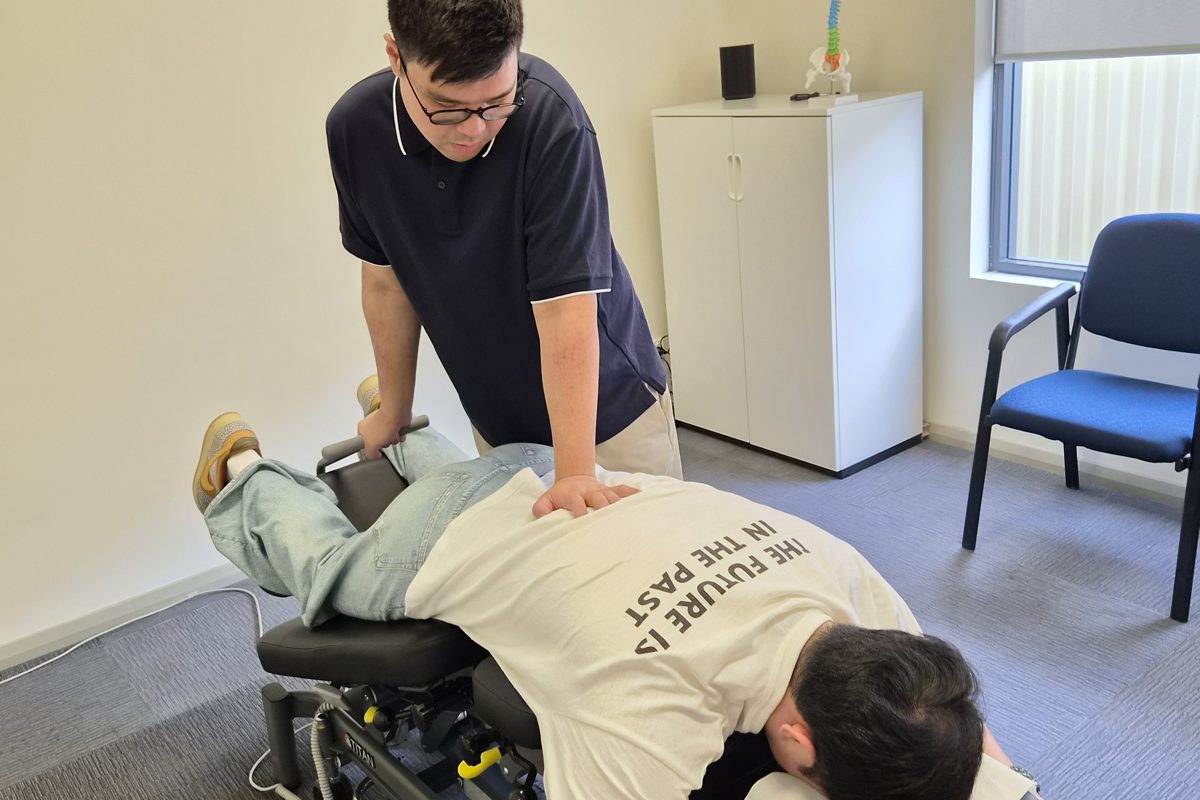
Most sitting-related lower back pain responds well to chiropractic care because the underlying issue is mechanical — joints that have stopped moving properly, muscles that aren't doing their job, and a movement pattern that needs retraining. We use Diversified and Gonstead adjustments to restore motion to the stuck segments, paired with practical advice for your specific setup (desk, car, gym, sleep position).
You'll usually feel a meaningful change in the first two or three visits. If you don't, we re-assess — and if we suspect a disc or nerve issue that needs imaging, we refer to a trusted Perth provider. We don't guess and we don't endlessly book you in for something that isn't working.
The Byford-specific bit
A big chunk of patients I see in Byford are FIFO workers flying out of Perth Airport, parents commuting up Tonkin Highway, and tradies based around Mundijong, Cardup and Serpentine-Jarrahdale. The seated-pain pattern looks slightly different for each of you, but the principle is the same: figure out what's stuck, restore the movement, retrain the position, and give you the homework that keeps it from coming back.
If you'd rather chat first, give the clinic a call on 0485 554 932. Otherwise book online — most new patients are in the chair within 24 hours.
— Dr Norris
Chiropractor, Uprise Chiropractic Byford